
Should You Translate to Your Native Language When Learning German? What the Research Actually Says
Translation is either a crutch or a shortcut, depending on who you ask. We went through the research on both sides — total immersion and native-language support — to map out exactly when translating helps you learn German faster, when it quietly holds you back, and how to use each approach at the right moment.
The oldest argument in language learning.
Ask two German teachers whether you should translate new words into your native language, and you'll likely get two confident, opposite answers.
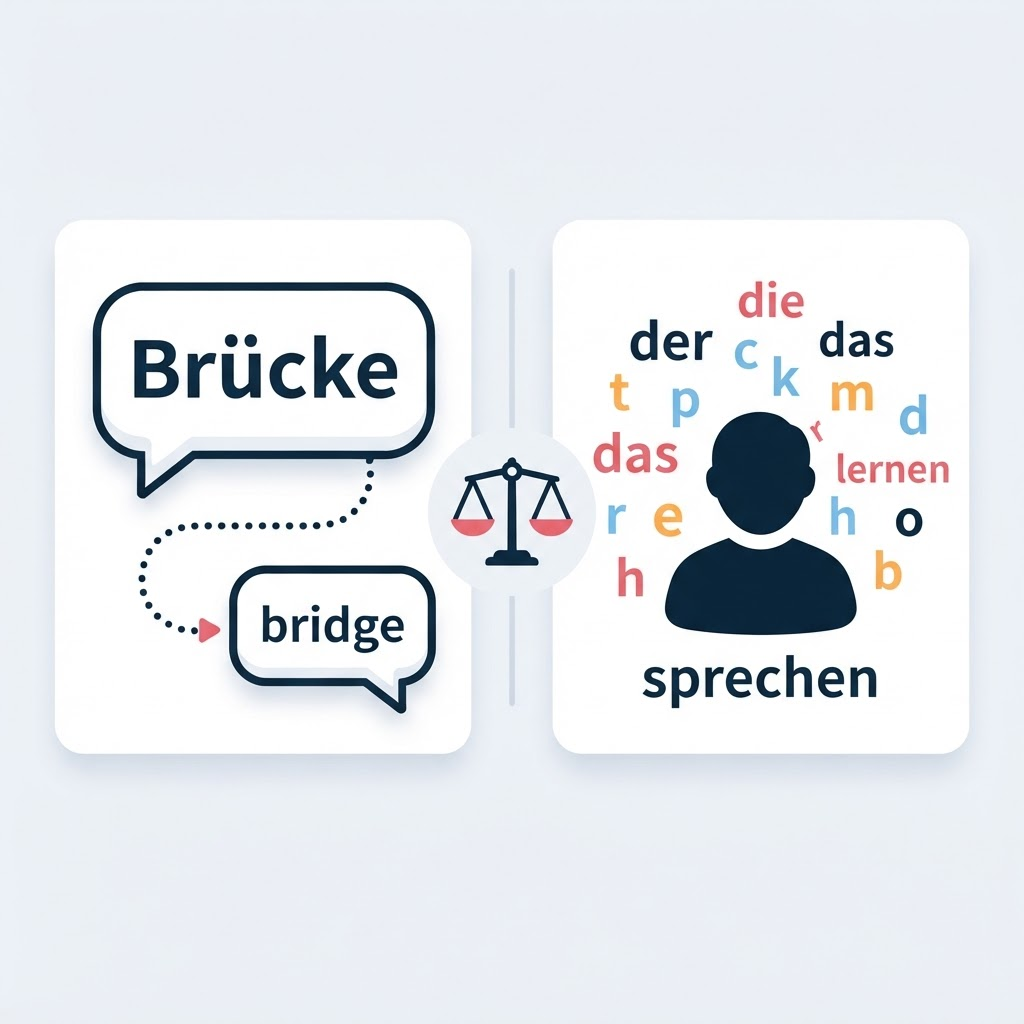
One will tell you translation is a crutch: "You'll never think in German if you keep routing everything through English or Spanish or Turkish." The other will tell you it's a shortcut: "You already know what a bridge is. Why act like you don't?"
Both are right. Both are wrong. It depends entirely on when, what, and how you translate.
This article maps out the full picture — the genuine advantages of using your native language, the genuine costs, what research on second-language acquisition actually supports, and a practical playbook for German learners at every level from A1 to C1.
And yes: we recently shipped two features in Prepilingo built precisely for the moments when translation helps — while keeping the app immersion-first for everything else. We'll show you where they fit into the picture, honestly, alongside the cases where you shouldn't use them at all.
Two camps, one hundred years of history.
The argument is older than most of the exams you're preparing for.
For most of the 19th century, languages were taught through the Grammar-Translation Method: memorize rules, translate sentences back and forth, treat the language like Latin. It produced learners who could parse a sentence beautifully and couldn't order a coffee.
The backlash came with the Direct Method and later the audio-lingual and communicative movements: no native language in the classroom, ever. Meaning had to be inferred from context, gesture, and pictures. Stephen Krashen's influential Input Hypothesis (1982) gave the immersion camp its scientific backbone: we acquire language when we understand messages — comprehensible input — not when we memorize equivalences.
Then the pendulum swung again. From the 1990s onward, researchers started actually measuring what happens when learners use their first language (L1) — and the results complicated the story:
So the honest summary of a century of research is this:
Your native language is an excellent bridge and a terrible residence.
Let's break down exactly what that means.
The case FOR translating: what your native language does well.
1. It establishes meaning instantly
You already own a complete conceptual world — you know what a bridge, an appointment, or a rental contract is. When you meet die Brücke, a one-second glance at a translation connects the new form to a concept you've spent your whole life building. Inferring the same meaning from context alone can take multiple exposures — and worse, you might infer it wrong and rehearse the error.
Research verdict: for establishing the initial meaning of concrete vocabulary, L1 translation is the fastest, most reliable tool available — especially at A1–B1.
2. It reduces cognitive load when content is hard
Cognitive Load Theory (Sweller) is unambiguous: working memory is small. When you're reading a B1 text about Austrian rental law and you hit four unknown words in one sentence, your working memory is fully occupied just decoding — nothing is left over for actually learning. A quick translation of one blocking word frees capacity to process the other 90% of the sentence in German.
Research verdict: strategic translation of blocking words keeps you inside the comprehensible-input zone instead of below it.
3. It prevents wrong guesses from fossilizing
Contextual guessing has a dirty secret: learners guess wrong constantly, feel confident, and never check. German is full of traps — das Gift means poison, not gift. bekommen means to receive, not to become. die Fabrik is a factory, not fabric. A two-second translation check catches a false friend before it settles in.
4. It respects how adult brains actually work
Children acquire their first language without translation because they have no other language. You do. Pretending otherwise doesn't make you a child again — it just makes you a slower adult. Adults consistently outpace children in the early stages of learning precisely because they leverage existing knowledge, literacy, and explicit reasoning.
5. It keeps frustration — and dropout — down
The single biggest predictor of language-learning failure isn't a bad method. It's quitting. A learner who can resolve a blocking confusion in two seconds stays in the text, keeps the reading habit, and comes back tomorrow. One who has to fight for every word often doesn't.
The case AGAINST translating: where it quietly sabotages you.
1. It builds a slow mental pipeline
If every German sentence you produce is composed in your native language first and then translated, you will always be too slow for real conversation — and for the speaking section of your exam. Fluency means German words connecting directly to meaning, without a detour. Every unnecessary translation rehearses the detour.
2. Word-for-word mapping breaks German
German doesn't map onto other languages one-to-one, and translation hides that:
| You want to say... | Word-for-word translation | Actual German |
|---|---|---|
| I'm waiting for the bus | Ich warte für den Bus ✗ | Ich warte auf den Bus |
| I'm interested in music | Ich bin interessiert in Musik ✗ | Ich interessiere mich für Musik |
| It depends on the weather | Es hängt an dem Wetter ✗ | Es kommt auf das Wetter an |
Prepositions, separable verbs, word order, reflexives — the parts of German that exams love to test are exactly the parts that translation gets wrong. They can only be absorbed as German, in German patterns, through German examples.
3. Grammatical gender has no translation
Your native language cannot tell you that it's der Löffel, die Gabel, and das Messer (three cutlery items, three genders). Learners who study words as bare translations — Löffel = spoon — systematically fail Kasus questions later, because half the German case system depends on gender they never stored. A word learned without its article is half a word.
4. It steals retrieval practice
The retrieval effect is one of the most robust findings in memory science: the struggle to recall something is what strengthens it. Every time you reach for a translation before trying to remember, you skip the very rep that would have made the word stick. Convenience and learning pull in opposite directions here.
5. Comprehension tolerance is an exam skill
Every German exam — ÖIF, ÖSD, Goethe, telc, TestDaF, DTZ — puts unknown words in front of you on purpose. Reading and listening sections test whether you can extract meaning despite gaps. There is no long-tap in the exam room. If you've never practiced tolerating ambiguity, the first time an unknown word doesn't panic you shouldn't be on test day.
The balanced scorecard.
| Situation | Translate? | Why |
|---|---|---|
| Meeting a new concrete noun (A1–B1) | ✓ Yes | Fastest reliable form-meaning link |
| A single word blocks a whole paragraph | ✓ Yes | Protects comprehensible input |
| Suspected false friend | ✓ Yes | Catch it before it fossilizes |
| Abstract grammar explanations at low levels | ✓ Mostly | L1 explanation cuts cognitive load |
| Checking your guess after guessing | ✓ Yes | Confirms retrieval practice |
| Words you've already looked up twice | ✗ No | Force retrieval — that's the learning rep |
| Prepositions, verb+preposition pairs | ✗ No | Must be learned inside German patterns |
| Composing sentences for speaking/writing | ✗ No | Builds the slow pipeline |
| Gist reading / listening practice | ✗ No | Tolerating gaps is the skill being trained |
| Final weeks before an exam | ✗ Rarely | Simulate real exam conditions |
The pattern is clear: translation is for meaning acquisition; immersion is for skill building. You need both — at different moments.
How we built this into Prepilingo.
Prepilingo has always been immersion-first, and it stays that way. From your very first A1 lesson, the content is in German — instructions, readings, listenings, everything. That's deliberate: from day 0 you're getting familiar with how German looks, sounds, and behaves, because the exam you're preparing for is 100% in German and the life waiting after it is too.
But immersion-first was never supposed to mean dictionary-in-the-other-hand. Leaving the app to paste a sentence into a translator breaks focus, kills the reading flow, and — as the research above shows — sometimes you genuinely need that two-second meaning check. So we built the bridge into the lessons themselves.
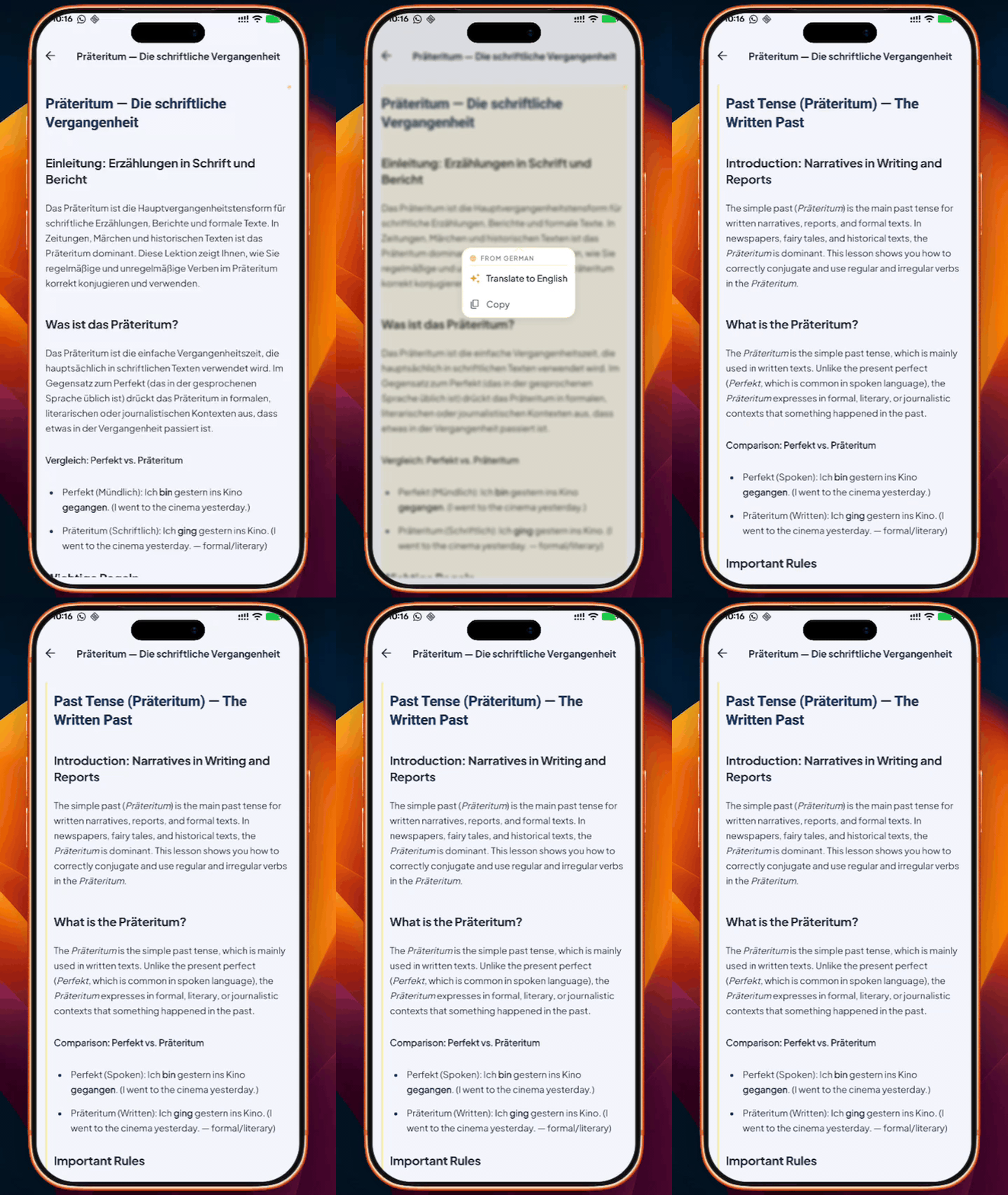
Long-tap to translate in place
Long-press any paragraph in any lesson — theory, readings, exercises — and it translates into your language, right where it is. Release, and it's German again. No app-switching, no copy-paste, no losing your place in the text. The friction is low enough to unblock you and high enough that you won't lazily read the whole lesson translated.
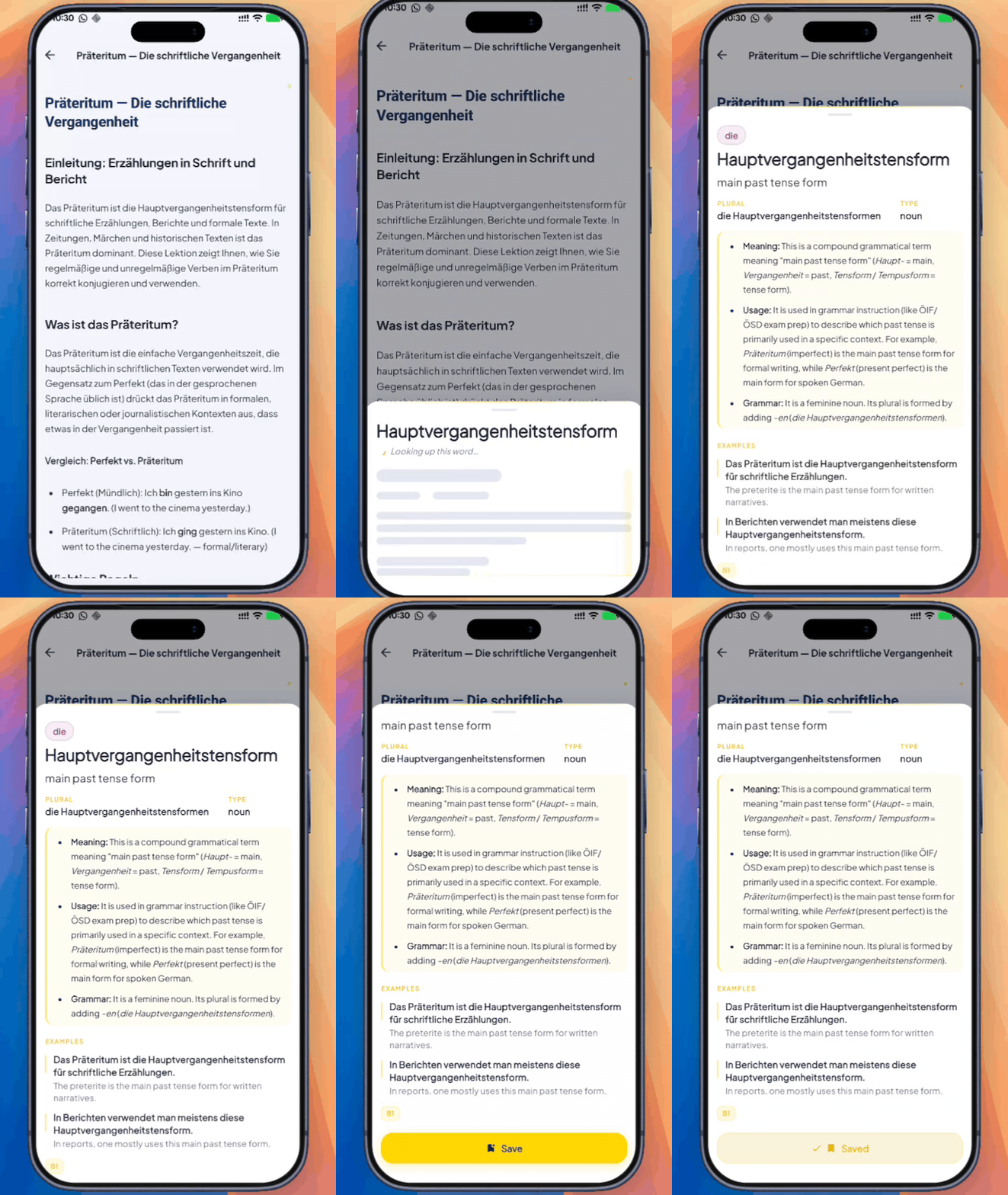
Tap a word for the full picture
Tap any single word in a lesson and you get more than a bare translation — because a bare translation is half a word. You see:
This is the research made tangible: the L1 gives you the instant form-meaning link, and everything else — gender, context, pronunciation, collocations — stays firmly in German, where it belongs.
Both features are live now in the app.
Download Free on Android → | Download on iOS →
The playbook: how much translation at each level.
A1–A2: Translate generously, but always with the article
At this stage, translation is your friend. You need thousands of form-meaning links, fast, and L1 glosses are the most efficient way to build them. Two rules keep it healthy:
B1: Shift from translating words to confirming guesses
By B1 you know enough German for context to start doing real work. Make contextual guessing your default and translation your verification step. Use the long-tap when a passage genuinely blocks you — Austrian rental contracts and German bureaucratic letters have earned it — but let easy content stay entirely in German.
B2: Translation becomes the exception
At B2, most lookups should be German-to-German thinking: What else could this word mean? What's the root? Which preposition does this verb take? Reserve translation for false-friend checks and genuinely opaque abstractions. If you're translating more than a couple of words per page, the text is either too hard — or the habit has outlived its usefulness.
C1: Live in German
At C1, your native language should appear only for precision work — legal nuances, technical terminology, translation as a profession rather than a crutch. Everything else, including your internal monologue about German itself, belongs in German.
The final weeks before any exam
Whatever your level: in the last two to three weeks before your ÖIF, ÖSD, Goethe, telc, TestDaF, or DTZ exam, wean off translation deliberately. The exam room has no long-tap. Practice the way you'll be tested — that's also exactly how the Final Push mode in our Intelligent Curriculum Engine structures your last 7 days.
The honest conclusion.
The immersion camp is right: fluency, grammar intuition, exam performance, and the ability to actually live in German-speaking countries are built in German, through German, surrounded by German. That's why Prepilingo puts you in German from day 0.
The translation camp is also right: your native language is the fastest bridge to meaning ever invented, and refusing to use it — at the right moments — is ideology, not pedagogy.
So use the bridge. Just don't live on it.
Download Prepilingo Free on Android → | Download on iOS →
"Your native language is an excellent bridge and a terrible residence."
Prepilingo is an independent educational platform developed by MagicusPrime LDA. We are not affiliated with, endorsed by, or approved by ÖSD, ÖIF, Goethe-Institut e.V., telc GmbH, TestDaF-Institut, BAMF, or any other official examination authority. All references to exam names are used solely for descriptive and educational purposes.
Ready to Start Your Exam Preparation?
Download Prepilingo and practice with AI-powered feedback on reading, writing, listening, and speaking.